Source: Wang et al. (2008). Combinatorial patterns of histone acetylations and methylations in the human genome. Nature Genetics 40:897-903.
Histone modification is one of the strategies employed by the eukaryotic systems to regulate their gene expression. For example, histone acetylation acts as an activator; whereas, methylation (depending on the site) can both be a repressor and activator. The "histone code hypothesis" states that a combination of histome modifications acts as an indicator of the chromatin state. Using ChIp-Seq technique, the authors make genome-wide maps for 18 different acetylations and 19 different methylations. Their results adds fascinating knowledge to our understanding of histone modifications. For example, they find a positive correlation between acetylation sites and expression, as previously known, but they show spacial arrangements for different types of acetylation. Some of these modifications are focused on TSS (transcription start site); whereas, others are in promoters or even in the gene itself.
Of the 4339 combinatorial patterns observed by the authors, most occur only once. 13 of these patterns, being the most frequent ones, are located in more than 62 genes each. Comparing the presence of these patterens with gene-expression data, the authors have classified the patterns into three distinct groups:
1. Low expression: High occurrence of H3K27me3 modification and other methylations but not acetylation.
2. Average expression: Generally including backbone modifications.
3. High expression: H2BK5me1, H4K16ac, H4K20me1 and H3K79me1/2/3 in addition to the modification
backbone.
I won't detail all the observations but they also report distinct histon modification patterns at enhancer sites.
Monday, August 18, 2008

Friday, August 15, 2008
Identifying Unknown Metabolic Genes
Source: Allen, J., Davey, H.M., Broadhurst, D., Heald, J.K., Rowland, J.J., Oliver, S.G., and Kell, D.B. (2003) High-throughput classification of yeast mutants for functional genomics using metabolic footprinting. Nature Biotechnology, 21(6): 692-6

Gene deletion strains of yeast were grown up in media, and the media was taken out at specific time points for mass-spec analysis. By measuring extracellular metabolites (footprinting), they were able to more quickly and easily get an idea on cellular metabolism. The authors then used discriminate function analysis and principal components analysis to map out the metabolomes of their strains and discover grouping according to gene-deletion. This was an effective way to classify unknown gene deletions, observing through ‘guilt-by-association’ which groups they fell in and thus what the gene most likely encoded.
Some side notes:
-Fingerprinting: measuring intracellular metabolites
-Footprinting: measuring extracellular metabolites
-“Yet the metabolome…should show greater effects of genetic or physiological changes and thus should be much closer to the phenotype of the organism.”
-Marked changes in metabolome between log-phase and stationary phase growth
-Discriminant Functional Analysis: Using multiple variables to determine group membership. Usually trained on a set where both membership and variables are known, then used on samples where only variables are known to derive membership.
-Mutants could be distinguished based on footprinting
I found this to be simple, understandable high-throughput approach, but with some serious failings. It is easy to conceive of a gene-deletion having a downstream metabolic effect, classifying it by such an effect may mask it's true purpose. Proteins that are involved in the same functional pathway, yet at grossly different points, may be grouped falsely; though they would at least be correctly assigned to the same function. As a springboard toward verification and a method to narrow down candidate genes, this database will have its uses.
Thursday, August 14, 2008
mRNA Self-cleavage: Another Strategy for Gene Expression Regulation
Source: Martick et al. (2008). A discontinuous hammerhead ribozyme embedded in a mammalian messenger RNA. Nature 454:899-902.
Hammerhead ribozyme is an RNA with catalytic activity which is capable of self-cleavage. The authors, attest the hypothesis that ribozymed may reside in mRNA and thus control the stability of the mRNA through auto-catalytic self-cleavage. They found three occurrences of hammerhead ribozyme in rodent 3' UTRs; Clec2d and Clec2e (which are paralogs) and Clec2d11 (a homolog of Clec2d). Subsequent homology searches succeeded in finding homologs of these genes in other mammals as well (e.g. horse and platypus). Below you see the general secondary structure of these embeded ribozymes.
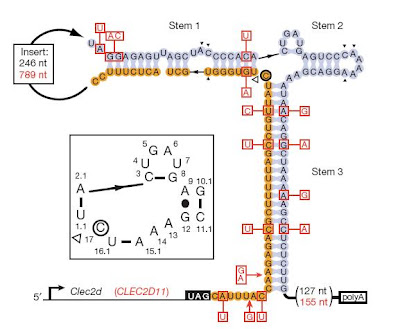
Using the Clec2d and Clec2e in vitro transcription, the authors showed that cleavage takes place at the predicted sites; whereas, in transcripts with a mutant ribozyme the transcript stays intact. They also used reporter constructs to test the expression level of lucipherase gene in the presence and absence of this ribozyme in its 3' UTR. They showed that addition of this ribozyme downregulates the transcript level.
Overall, this is a very intersting paper introducing a new strategy for gene regulation. I guess there are many more of these mechanisms are waiting to be found. However, these strategies, as elegant as they are, are far from universal.
Hammerhead ribozyme is an RNA with catalytic activity which is capable of self-cleavage. The authors, attest the hypothesis that ribozymed may reside in mRNA and thus control the stability of the mRNA through auto-catalytic self-cleavage. They found three occurrences of hammerhead ribozyme in rodent 3' UTRs; Clec2d and Clec2e (which are paralogs) and Clec2d11 (a homolog of Clec2d). Subsequent homology searches succeeded in finding homologs of these genes in other mammals as well (e.g. horse and platypus). Below you see the general secondary structure of these embeded ribozymes.

Using the Clec2d and Clec2e in vitro transcription, the authors showed that cleavage takes place at the predicted sites; whereas, in transcripts with a mutant ribozyme the transcript stays intact. They also used reporter constructs to test the expression level of lucipherase gene in the presence and absence of this ribozyme in its 3' UTR. They showed that addition of this ribozyme downregulates the transcript level.
Overall, this is a very intersting paper introducing a new strategy for gene regulation. I guess there are many more of these mechanisms are waiting to be found. However, these strategies, as elegant as they are, are far from universal.
Tuesday, August 12, 2008
Modeling Chaos: A Long-term Study of a Mesocosm
Source: Beninca et al (2008). Chaos in a long-term experiment with a plankton community. Nature 451:822-825.
Ecological systems are chaotic in nature. Theoretically, this chaos can emerge from competition, predator-prey interactions and food-chain dynamics. Empirical data, however, is scarce mainly due to the inherent complication of disentangling the external variables (e.g. weather) from intrinsic interactions. In this study, the authors study a complex planktonic community for the first time. This community was cultured in a controlled microcosm with constant external conditions for more than eight years. The species in this community (along with the food-web structure) are given in the figure below.

These species were counted twice a week for 2319 days (690 data points). These data points very well capture the correlations originating from competition, predator-prey or even mutualism interactions in the community. These results show that species interactions can create significant fluctuations in the population of each species. In addition, they showed that while in short term the system was predictable, exceeding 15 days significantly decreased predictability. This abrupt decrease is a marker for chaos.
In sum, this small community shows signatures of chaos through fluctuations in the abundance of species.
Friday, August 8, 2008
Regulation by Exile: How a Transcription Factor Regulates A Secretion System
Source: Raghavan et al (2008). Secreted transcription factor controls Mycobacterium tuberculosis virulence. Nature 454:717-721.
M. tuberculosis relies on a Type VII secretion system, termed ESX-1, to export the virulence factors targeting the host macrophages. In a transposon mutation genetic screen, the authors stumbled upon a mutant with elevated levels of IL-12 from macrophages (a common trait of ESX-1 mutants). They map the insertion to 13 nt upstream of Rv3849 which they later renames EspR. They made two other key observations:

M. tuberculosis relies on a Type VII secretion system, termed ESX-1, to export the virulence factors targeting the host macrophages. In a transposon mutation genetic screen, the authors stumbled upon a mutant with elevated levels of IL-12 from macrophages (a common trait of ESX-1 mutants). They map the insertion to 13 nt upstream of Rv3849 which they later renames EspR. They made two other key observations:
- EspR is a substrate of ESX-1, thus exported from the cell.
- EspR is required for the transcription regulation of ESX-1.

Thursday, August 7, 2008
Complexity vs. Evolovability: The Role of Pleiotropy in Evolution
Source: Wagner et al. (2008). Pleiotropic scaling of gene effects and the 'cost of complexity'. Nature 452: 470-472.
There is a intuitive notion among the biologists which indicates that complexity decreases evolvability mostly due to the pleiotropic effects. The bottom line is that a mutation in a complex organism results in more drastic changes (both in quantity and quality). The authors of this paper challenge this point of view through studying the quantitative trait loci in a set of inbred mice. Their studied traits comprise a set of skeletal variables and phenotypes. The authors show that while there is a positive correlation between the magnitude of the effects and the number of traits affected (N), N is a very small number compared to what is generally thought. When we talk about the cost of complexity, we think that each mutation can potentially affect all the phenotypes through direct or indirect effects. However, evolution can control this through enforcing modularity. In a modular system, mutations in each subset has little effects on the system as whole. In other words, robustness and modularity decrease the cost of complexity.
There is a intuitive notion among the biologists which indicates that complexity decreases evolvability mostly due to the pleiotropic effects. The bottom line is that a mutation in a complex organism results in more drastic changes (both in quantity and quality). The authors of this paper challenge this point of view through studying the quantitative trait loci in a set of inbred mice. Their studied traits comprise a set of skeletal variables and phenotypes. The authors show that while there is a positive correlation between the magnitude of the effects and the number of traits affected (N), N is a very small number compared to what is generally thought. When we talk about the cost of complexity, we think that each mutation can potentially affect all the phenotypes through direct or indirect effects. However, evolution can control this through enforcing modularity. In a modular system, mutations in each subset has little effects on the system as whole. In other words, robustness and modularity decrease the cost of complexity.
Friday, August 1, 2008
The Symbiotic Microbiome in Charge of Training the Immune System
Source: Mazmanian et al (2008). A microbial symbiosis factor prevents intestinal inflammatory disease. Nature 453:620-625.
In general, reduced exposure to infectious agents throughout childhood increases the chance of allergic and auto-immune disease. Improvements in personal hygiene and the rampant use of antibiotics have direly affected our associations with our symbiotic microbiome. This paper is a very good example of such deregulations where the authors name the absence of Bacteroides fragilis as a cause for the emergence of colitis and other IBDs.
Here, the authors have shown that B. fragilis is essential for protection against colitis. Their experiments involves testing the germ-free mice grown in sterile conditions. Apparently, the presence of B. fragilis in the intestine switches the uneducated T cells (CD4+ CD45Rbhigh) to educated T cells (CD4+ CD45Rblow) that possess significant anti-inflammatory properties. B. fragilis affects the immune system through the production of PSA (polysaccharide A). ΔPSA strains lose their protective ability. PSA induces IL-10 expression in the intestine which is a potent anti-inflammatory agent.
We should utterly remember that B. fragilis is only one of the thousand symbiotic bacteria. Evolutionary interactions may have very well shaped our symbiotic bacterium as an often-forgotten organ.
Subscribe to:
Posts (Atom)

